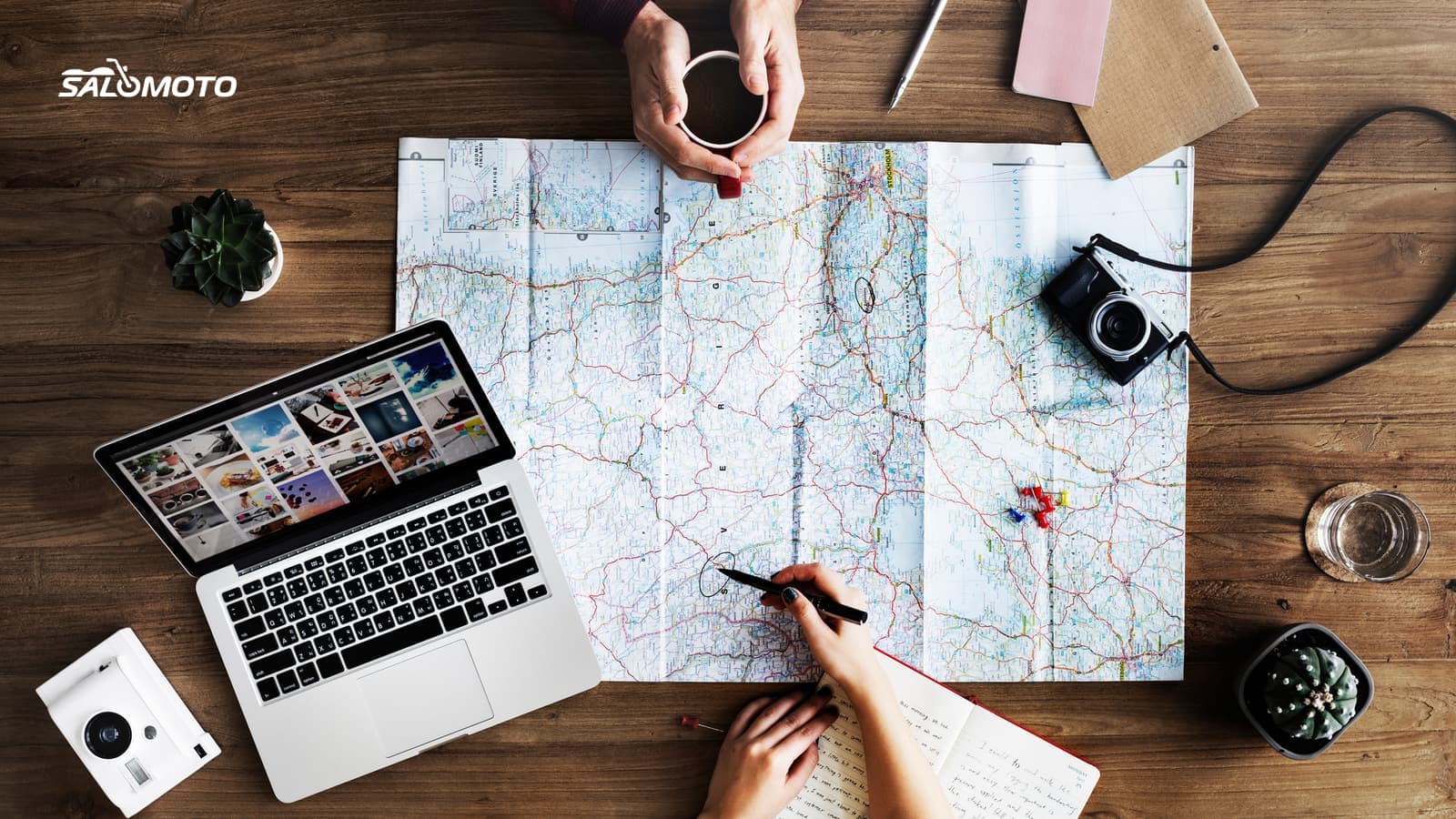
Start with the basics: time, people, bike
Before you pick a single road, answer three questions. They decide more about a good day than any stretch of twisties.
- How much time do you really have? Not "Saturday," but "out by nine, home by five, dinner at seven." That window is the hard limit; everything else bends around it.
- Who's riding? Solo, you set the pace. With a passenger, a group or a newly licensed friend, the ride gets shorter, the breaks get longer and the roads get simpler.
- What does your bike do well, and what do you want to ask of it? Tank range, seat comfort, wind protection and luggage all change the plan. A small-displacement bike gets planned differently from a full dresser; matching the route to the motorcycle covers that.
Those answers set the length. How many miles make sense in a day depends on experience, roads and breaks, which how far to ride in a day breaks down. If this is your very first ride beyond the neighborhood, start with planning your first motorcycle ride, where everything is deliberately shorter and easier. The same steps scale up to longer trips, with stages and overnight stops added (multi-day trips).
Build the route in layers
A good route comes together the way a sketch does: outline first, detail later.
- Pick a theme. Curves, views, empty backroads, or a destination like a lake, a mountain pass or a favorite diner? A clear theme makes every later choice easier.
- Choose the shape. If you start and finish at home, a loop ride almost always beats riding the same road out and back.
- Pin the fixed points. Start, end and two to four stops you care about. Planning a route with multiple stops covers how to order them.
- Choose the road type. A curvy profile in a planner favors curvier roads. Skipping the interstate is a matter of taste and of what you ride, not a rule for every trip (routes without highways).
- Check the line. Zoom along the whole route: long stretches through town, a strip-mall corridor, a gravel section you didn't expect? Drag points until the line matches your theme; planning on a map goes deeper.
No planner knows which road you'll love. It knows road classes and map data, not character. A look at satellite view or at ride reports from riders who know the area pays off before you commit.
Budget your time honestly
The riding time a route planner shows is almost always pure moving time. Breaks, gas, photos and rolling through small towns come on top. Forget that and you'll spend the afternoon racing the clock, which is the opposite of why you went riding.
| Piece | What to think about |
|---|---|
| Moving time | the planner's estimate, often optimistic on twisty roads |
| Breaks | lunch, coffee, stretching before you feel tired |
| Gas | based on your real range, not the low-fuel light |
| Buffer | detours, traffic, a road you want to ride twice |
| Daylight | home before dusk, especially in spring and fall |
A quick example: if the planner shows four hours of riding, two or three breaks and a little buffer can easily turn that into a six- to seven-hour day. How riding-time estimates work explains where they tend to be off.
Stops, gas and a backup plan
Breaks belong in the plan, not in your hopes. Put them where there's something to see or eat and where you can park legally and safely off the road. Planning a ride around stops collects ideas for overlooks, diners and meetup spots.
For gas, plan the stop before you need it. On rural roads, especially across parts of the West, stations can be far apart, and small-town pumps aren't always open late. If you don't know your bike's real range, be conservative; gas stops on a motorcycle trip has more.
The night before or that morning, check the forecast and current closures; many states run a 511 traveler-information service for road conditions. Then look at one alternative for the stretch that matters most. Weather and season covers how they change a ride.
Get the route onto the bike
A route on a screen only helps if you can follow it on the road. Riders usually do one of three things:
- Load a GPX file onto a motorcycle GPS or into a navigation app. It's the most reliable way to ride the line you planned; the GPX guide explains the format.
- Open a link in a maps app. Convenient, but the app often calculates its own version.
- Tape a note to the tank bag: the key towns and turns in order, as a fallback.
Set up your GPS before you roll out, not at a red light, and make sure your phone is charged or powered from the bike. For a look at which free planners exist and what they include, see free motorcycle route planners.
Salomoto today (as of November 2026): The Salomoto route planner plans routes within Germany only, free and with no account: start, destination and stops, profiles from fast to very curvy, optional avoidance of motorways, tolls and ferries, and a loop back to your start. It shows distance, estimated riding time without breaks and an elevation profile, and lets you download the route as a GPX track or open an approximate version in Google Maps. Salomoto doesn't navigate and doesn't show gas stations, weather or closures; your GPS and the usual services handle that. With a free account you can save and share routes and log rides by hand in RoadDex, which is a logbook, not a GPS tracker.
Night-before checklist
- Whole route reviewed on the map, problem spots moved
- Total time with breaks and buffer fits your window
- Lunch and a gas stop planned
- Forecast and closures checked, one alternative in mind
- GPX on your GPS or phone, battery charged, mount secure
- Bike checked: tires, controls, lights, oil, chassis, stand (the T-CLOCS routine taught in rider courses)
- Someone knows your route and rough return time
- Group ride: meeting place, time and phone numbers agreed (riding with friends)