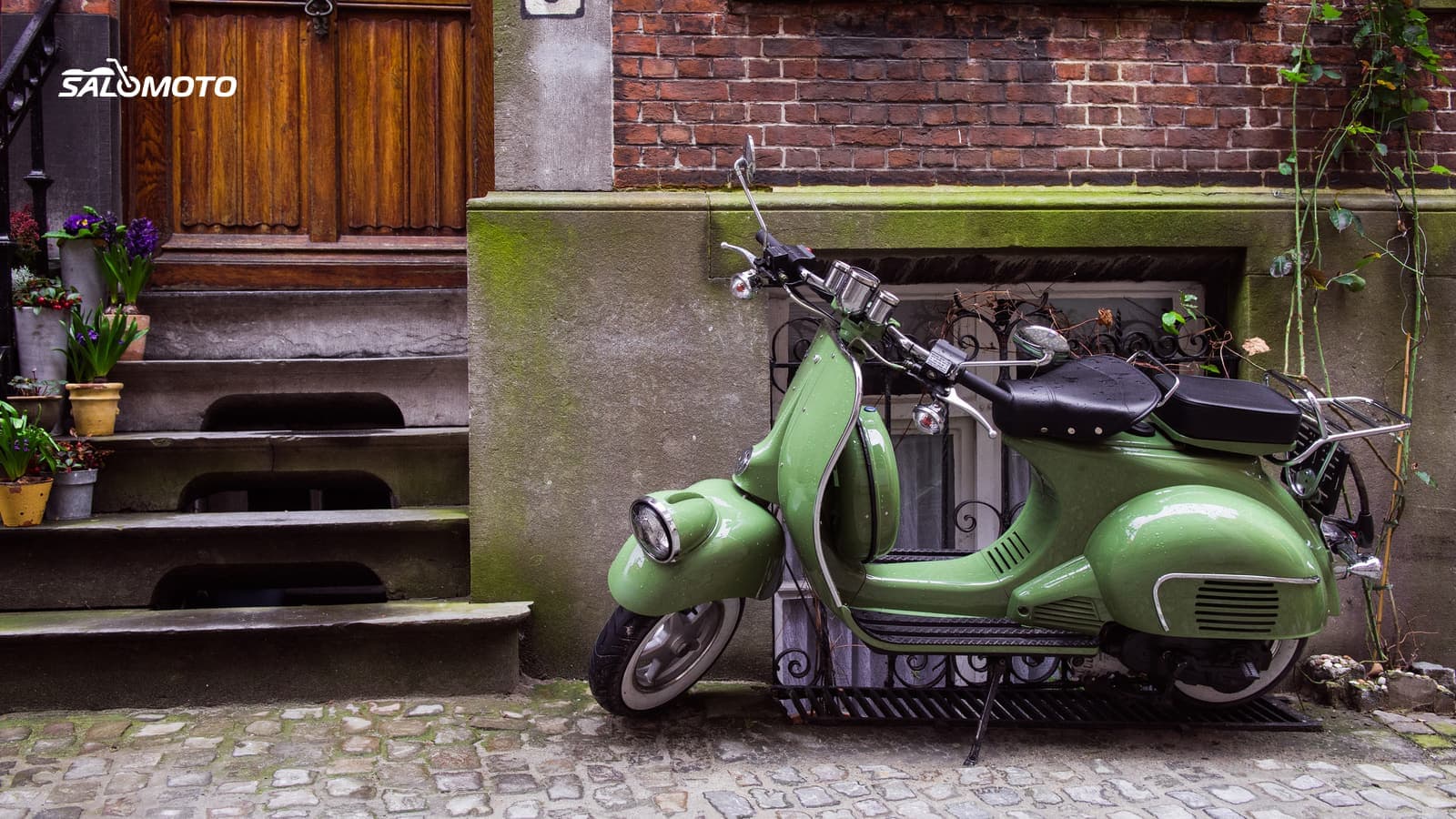
Start with your roads, then pick the family
Vespa isn't one model but a handful of families that look alike and ride noticeably differently. If you're still deciding whether it should be a Vespa at all, start with Vespa or another scooter?. This page is the next step: which Vespa.
The order that works:
- Roads: city streets only, fast arterials, two-lane highways, or freeway too?
- License: it decides which engine class you can ride legally.
- Body size: compact or large, depending on your build, your parking and whether you carry a passenger.
- Style: color, special edition, accessories. They matter, but they come last.
New to two wheels altogether? Read your first scooter first. Riding mainly to work? Weather, costs and parking are covered in commuting by motorcycle or scooter.
Compact or full size: Primavera, Sprint and GTS
The current Vespa families fall roughly into two sizes. The Primavera and Sprint are the compact Vespas, which Piaggio calls "small body" models; they share the same basic shape and differ mostly in design. The GTS is the big Vespa: longer, wider, heavier, with more room for two and more composure on fast roads. Alongside them, Piaggio has made limited design models such as the 946, which are closer to collector pieces than daily scooters.
The steel body
Piaggio describes the Vespa's body as load-bearing and built entirely from steel. There's no tube frame hiding under plastic panels; the sheet metal is the frame. In daily life that means the scooter feels solid, a tip-over tends to leave dents and scratched paint rather than cracked plastic, and repairs are bodywork and paint jobs. You also feel the weight when you maneuver it, especially on a GTS.
Wheels, seat and storage
The current Primavera and Sprint roll on 12-inch wheels, and Vespas in general ride on smaller wheels than big-wheel scooters. That makes them nimble between cars and in tight spaces, while potholes, expansion joints and rough pavement come through more. With the seat, height is only part of the story: how wide it is at the front changes how easily your feet reach the ground. More on that in motorcycles for shorter riders. Whether your helmet fits under the seat depends on the family and the helmet's shape, so bring your own helmet to the dealer instead of trusting the brochure.
Engine class and the license you need
| Engine class | Vespa families | What it suits |
|---|---|---|
| 50cc or electric moped | Primavera, Sprint | short, slow city trips |
| 125cc and 150cc | Primavera, Sprint | city and suburbs |
| Electric, about 42 mph top speed | Primavera Tech | city with faster streets |
| 310cc | GTS | fast arterials, highway, two-up |
Piaggio lists the Primavera and Sprint with 50, 125 and 150cc engines plus two electric versions, but what's sold here changes by market and model year, so check the current US lineup with a dealer. The GTS 310 replaced the 278cc GTS 300 in late 2024; Piaggio quotes 25 hp for it, the most of any Vespa so far. Whether the big body comes with a smaller engine in your market is a question for the dealer's price list.
Licensing rules vary by state. Moped definitions differ a lot: in New York, for example, the fastest moped class needs a motorcycle license and every moped must be registered, while California requires an M1 or M2 for mopeds. Above moped class, you're usually looking at a motorcycle license or endorsement, often Class M. Most states don't tier that endorsement by engine size, so the same license covers a small Vespa and a GTS. There are exceptions: Texas, for instance, has a restricted Class M for bikes up to 250cc for 15-year-olds. Check with your state DMV. The license basics by state are in which motorcycle with which license.
Buying new or used: what matters on a Vespa
The general trade-offs are in new or used motorcycle?, and budget plus a general used-bike check are on the beginners page. On a Vespa, add these:
- Read the bodywork: waves in the reflection, dull patches or a color mismatch between the side panels and the body suggest a crash or filler.
- Look for rust: under the floorboard strips and mats, along lower edges, inside the storage compartment.
- Check both side panels: scrapes on both sides usually mean it's been down.
- Match the paperwork: displacement and top speed on the title and registration must match the scooter. A moped that's been made faster no longer matches its papers; walk away.
- Ask for service records: the drive belt and variator wear, and records tell you more than a shine.
Know which generation you're looking at, too: per Piaggio, the Primavera and Sprint updated in late 2025 gained a rear disc brake and front-wheel ABS, so older ones may be equipped differently. Vintage Vespas with a hand-shifted gearbox are their own world: charming, but you shift on the handlebar, the brakes are from another era and ABS is usually absent. They're rarely the easy choice for a first daily scooter. On a used electric Vespa, the battery matters most; that's covered in electric motorcycle: yes or no?.
Special editions: style, not substance
For Vespa's 80th birthday in 2026, Piaggio showed, among others, a Primavera and a GTS in pastel green and the numbered Edizione Ottantesimo, limited to 1,946 units. According to Piaggio, it shares the technical base of the GTS 310 range. That's the pattern: special editions change paint, seat, wheels and badges, not weight, engine or license class.
So pick the family and engine first, then the edition. Paying extra for colors and details is perfectly fine if they make you happy. How much looks should weigh in overall is the subject of a motorcycle with style.
At the dealer: Vespa checklist
- Roll it off the center stand and put it back up: can you do it without a fight?
- Push it a few yards and turn it around, including backward
- Bring your own helmet and see whether it fits under the seat
- Sit on it: how wide is the front of the seat, where do your feet land?
- Have your passenger sit on it if you'll often ride two-up
- Test ride over rough pavement, not just smooth asphalt
- On a used one: compare the VIN, title and odometer with the listing
Legal information on this page refers to the United States, where rules vary by state.