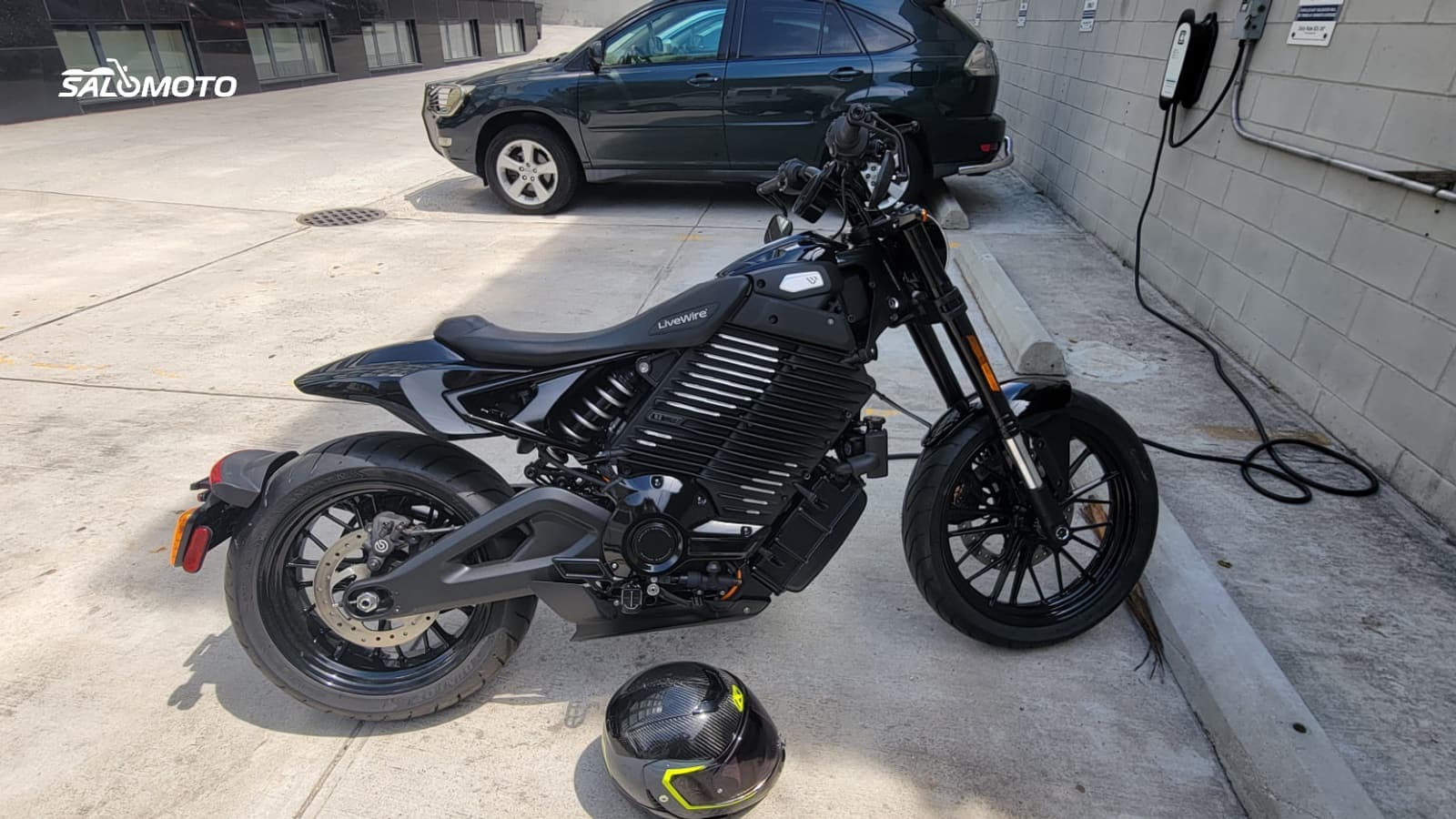
The real question: where will you charge?
With a gas bike, fueling is an afterthought: there's a station on every other corner and you're back on the road in five minutes. With an electric, charging becomes part of daily life, and it only feels easy when the bike gets power where it already sits: overnight in the garage, during the day in the employee lot. Public chargers are a good backup but a tiring primary plan, because you end up waiting next to the bike instead of letting it charge while you sleep or work.
So before anything else, find out:
- Is there an outlet at your parking spot you're allowed to use, even as a renter or in a shared garage?
- Can you charge at work, and does the bike sit there long enough?
- Does the bike have a removable battery you can charge indoors? Some smaller models do; full-size motorcycles rarely.
- Where's the nearest public charger for the days you cut it close?
| Your situation | Leans toward | Why |
|---|---|---|
| Garage outlet, steady commute | Electric | charges overnight, range is plenty |
| Charging only at work | Electric can work | fine if the bike is there every weekday |
| Street parking, no outlet | Gas | public charging costs time and planning |
| Long trips, spur-of-the-moment rides | Gas | a fill-up takes minutes, charging much longer |
| Second vehicle for around town | Electric | pairs with a car or gas bike for distance |
Real-world range vs. the rides you actually do
The manufacturer's number is a starting point, not your range. How far an electric goes depends more on how you ride than it does on a gas bike. Sustained highway speeds cut range sharply, because air resistance climbs steeply with speed. In stop-and-go traffic the bike recovers energy when you roll off and goes farther. Cold weather costs extra range, and charging often slows down in winter too, which matters if you plan on riding year-round.
So work backward from your own riding: take your longest regular ride, the fastest stretch on it and a cushion for cold mornings, then add a buffer so you never pull in nearly empty. If that still fits comfortably inside the real-world range from independent reviews, the electric works for you. If it doesn't, a gas bike is simply the honest answer.
Charging levels and plugs
- Level 1 (120-volt household outlet): many electrics can use one. It's slow, but overnight is usually enough for a commute.
- Level 2 (240-volt, J1772 plug): the common public and home charger. Charging speed is usually capped by the charger built into the bike, not the station.
- DC fast charging (CCS): only some models support it. If you ride longer distances often, make this a must-have.
Check the spec sheet for which ports the bike has and how long a full charge takes on the outlet you'll really use.
Licensing and incentives (as of November 2026)
Rules vary by state, so treat this as the general picture and confirm with your state DMV. Most states don't tier motorcycle licenses by engine size or power: a full-power electric needs the same motorcycle license or endorsement as a gas bike. Small, low-speed electrics can land in moped or motorized-scooter categories instead. New York, for example, sorts mopeds into classes by top speed, and California has a separate M2 class for mopeds and motorized bicycles. For the full licensing picture, see what you can ride on which license.
- Federal tax credit: the credit for two-wheeled plug-in vehicles (10 percent of the price, up to $2,500) covered bikes acquired through December 31, 2021. There's no federal credit for electric motorcycles in 2026.
- State and utility programs: some states and power companies offer rebates or special charging rates. Ask before you buy, and ask your DMV whether any EV-specific registration fee applies in your state.
Riding and owning: what actually changes
| Topic | Electric | Gas |
|---|---|---|
| Maintenance | no oil changes, valves or clutch | oil, filters, valve checks, clutch |
| Still there | brakes, tires, final drive, suspension | the same |
| How it feels | quiet, instant pull, no shifting | sound, gears, engine braking |
| Weight | the battery makes many models heavy | often lighter in the same class |
| Resale | battery health and fast-moving tech | used market is easy to read |
An electric rides quiet and direct. The pull is there the instant you twist the throttle, there's nothing to shift, and many models slow down on their own as you roll off, thanks to regenerative braking. Some riders love that from the first block; others miss the sound and the gear changes within a few miles. Whether a clutch matters to you at all is its own question, covered in automatic vs. manual motorcycle. You'll notice the weight most when you're pushing the bike around a garage. And at resale, the battery is the big unknown while the technology keeps moving, so trade-in values are hard to predict. For the long-run cost picture, see cheap motorcycles to own.
Who should go electric today, and who should wait
An electric fits well if you ride fixed, predictable distances, like a daily commute (see choosing a commuter motorcycle), you can charge at home or at work, and you like quiet riding without shifting. It's especially strong as a second vehicle next to a car or a gas bike.
Stick with gas for now if you have no parking spot with power, you take long trips or like to just keep going, your budget points to a good used bike, or the sound and the mechanics are part of why you ride.
On an electric test ride, also check:
- Ride your actual commute at your usual speed and watch the energy use
- Try the ride modes and the strength of the regenerative braking
- Push the bike backward and maneuver it in a tight space
- Have the dealer show you how it charges, with the cable that comes with it
- Ask about the battery warranty and, on a used bike, its battery health
Legal information on this page refers to the United States, where rules vary by state.