Curves alone don't make a great road
When riders recommend a road, they usually say "it's twisty." That's only part of the story. Curvature maps and curvy routing modes measure a road's geometry; how they work is covered in how to find twisty roads. Whether the road is actually good depends on things no map shows: how the curves link up, how far you can see, what the pavement is like and what's coming the other way.
A great road is one you can ride relaxed and focused without constant surprises. That sounds unexciting, but it's exactly the difference between a ride you want to repeat and one you're glad to be done with.
Seven criteria at a glance
| Criterion | Good sign | Warning sign |
|---|---|---|
| Rhythm | curves flow into each other, readable radii | decreasing-radius curves, abrupt changes |
| Sight lines | long views, open inside of curves | crests, brush, rock faces on the inside |
| Pavement | even, grippy, clean | patches, tar snakes, gravel, leaves |
| Width | center line, room for oncoming traffic | single lane, crumbling edges |
| Traffic and towns | few towns, little truck traffic | signals, weekend crowds, farm equipment |
| Roadside | clear shoulders, open run-off | trees, poles, rock walls right at the edge |
| Scenery and stops | views, safe pullouts | nowhere to pull off |
No road ticks every box. The table just helps you put into words why a road worked for you, or didn't.
Rhythm and sight lines: the heart of a twisty road
Rhythm comes from curves that follow each other logically. You brake, turn in, look to the exit and you're set up for the next one. What breaks it are curves that tighten toward the end and sudden switches from wide sweepers to a hairpin with no warning. On a map you can often spot those where a line curls in at the end of a bend.
Sight lines matter just as much. A curve with an open inside lets you see the exit early. Crests, dense brush, summer corn or a rock cut take that view away. The safety rule is simple: ride at a speed that lets you stop within the distance you can see to be clear. A posted limit is a maximum, not a target. Good sight lines don't make a road faster, they make it calmer.
Pavement and roadside: what holds you up and what catches you
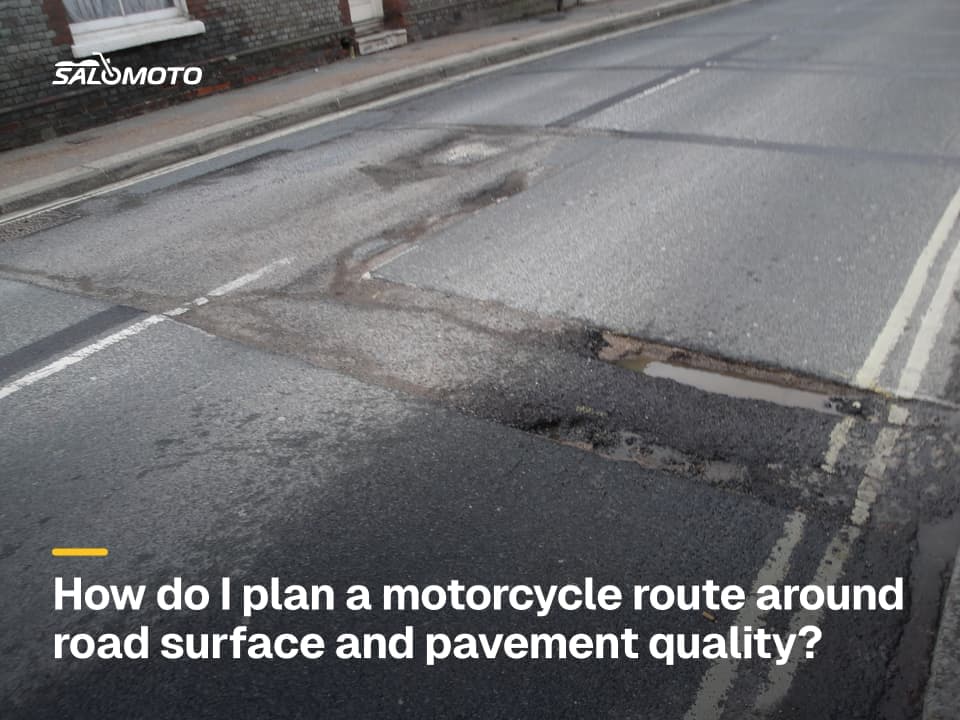
Pavement decides grip and confidence. Watch for patchwork repairs, slick tar snakes, rain grooves, manhole covers mid-corner and loose gravel after chip sealing. Highway agencies flag the same things: the Texas DOT's design manual lists loose gravel, rough or grooved surfaces, metal bridge decks and expansion joints among features that need extra care on a motorcycle. After winter, after rain and in fall with wet leaves, a great road can change a lot. How to check it beforehand is covered in how to plan by road surface.
The roadside tells you how forgiving a road is. Trees, utility poles and rock walls right at the edge leave little margin. Clear shoulders and open run-off give you room if something goes wrong.
Traffic belongs here too. The best road loses its charm when it's packed with weekend sightseers. When it's quieter is covered in twisty roads with little traffic.
Does the road suit you?
A road can be objectively excellent and still the wrong choice for you today. Ask yourself:
- Skills: Are you comfortable in tight, blind corners, or are wide, open sweepers a better match right now?
- Bike: A heavy tourer feels very different in hairpins than a light standard. For matching bike to road, see the Bike Match guide on a motorcycle for twisty roads.
- Energy and weather: Fatigue, cold or rain make any twisty road more demanding.
- What you're after: Curves, or mostly views? For the latter, see how to find scenic backroads.
If you want to get better in curves, an advanced rider course is the way to do it. Speed is never the measure of a good road.
Rate a road after your first ride
You only really know a road after you've ridden it. Write down your impressions while they're fresh:
- How was the rhythm, and where did something surprise you?
- Where were sight lines limited?
- How was the pavement, and where were gravel, dirt or patches?
- How much traffic, and at what time of day?
- Were there safe places to pull over for a break?
- Would you ride it again, and in which direction?
If the road is in Germany, you can rebuild it for free in the Salomoto route planner with the curvy or very curvy profile, which favors twistier roads, and save it to My routes with a free account. Salomoto doesn't rate or score road quality; that judgment stays with you. You can then log the ride by hand in RoadDex with the date, bike, distance, photos and a note. RoadDex records no GPS.